Core Problem & SQL Analysis
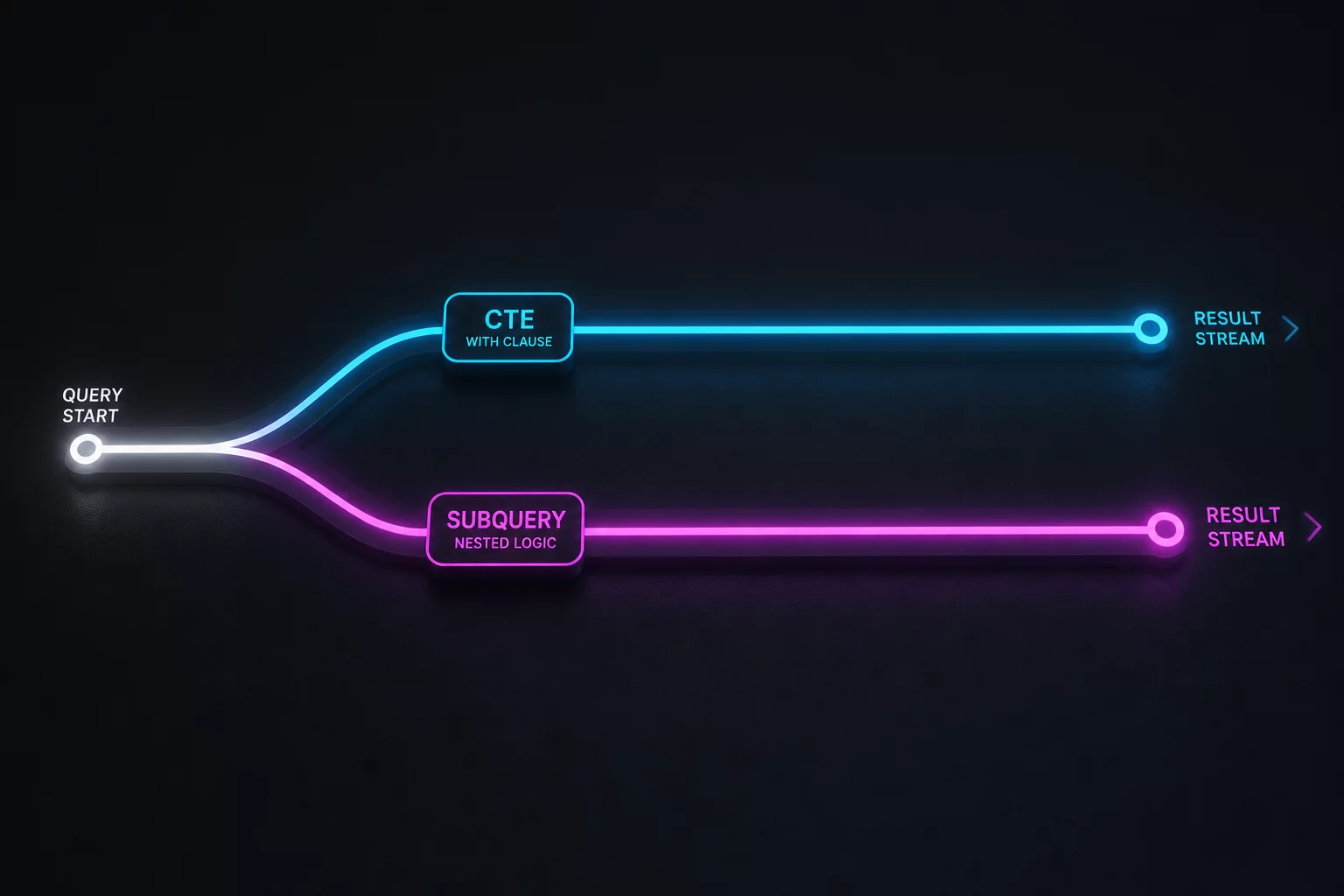
When designing complex database queries, selecting the correct structural approach is fundamental to communicating your intent to both the database optimizer and future maintenance engineers. Subqueries and Common Table Expressions (CTEs) are often viewed as interchangeable syntax wrappers. However, they carry distinct semantic meanings and execution profiles. A subquery is typically nested inside a main clause, binding its scope directly to the parent statement. It implies a localized filter or lookup, suggesting to the reader that the nested dataset is secondary to the primary query flow. Conversely, a CTE (Common Table Expression) defines a logical, named result set that acts like a temporary view. CTEs promote a linear, top-down reading pattern, signaling an intent to build sequential, modular steps of data transformation. From an execution perspective, modern database engines treat simple subqueries and non-recursive CTEs similarly, inline-expanding them into the main plan. But in older engines or specific dialects, CTEs act as optimization barriers, materializing temporary tables that alter index usage. Understanding these structural pathways is key to maintaining clean, high-performance database architectures.
Why This Query Intent Fails
Often in production data environments, developers default to simple joins without reviewing the row multiplicity. When duplicate keys exist or table joins do not represent direct dependencies, metrics like revenue and active user count become inflated.
Key Takeaway
Always verify the primary keys of joined datasets and execute aggregate checks before using nested layouts. Improperly scoped aggregation levels will distort downstream BI dashboard reports.
Discussion & Reviews
No Comments Yet
Be the first to share your thoughts on this optimization case!
Leave a Comment